CPU Architecture Explained
📚 Get the "Inside the Core: How the CPU Works" E-Book at: https://bitlemon.lemonsqueezy.com/checkout/buy/90eb3e9e-6690-4339-8b62-3b97690c681c?utm_source=you...

BitLemon
155.6K views • Nov 9, 2025
About this video
📚 Get the "Inside the Core: How the CPU Works" E-Book at: https://bitlemon.lemonsqueezy.com/checkout/buy/90eb3e9e-6690-4339-8b62-3b97690c681c?utm_source=youtube&utm_medium=video&utm_campaign=cpu-architecture
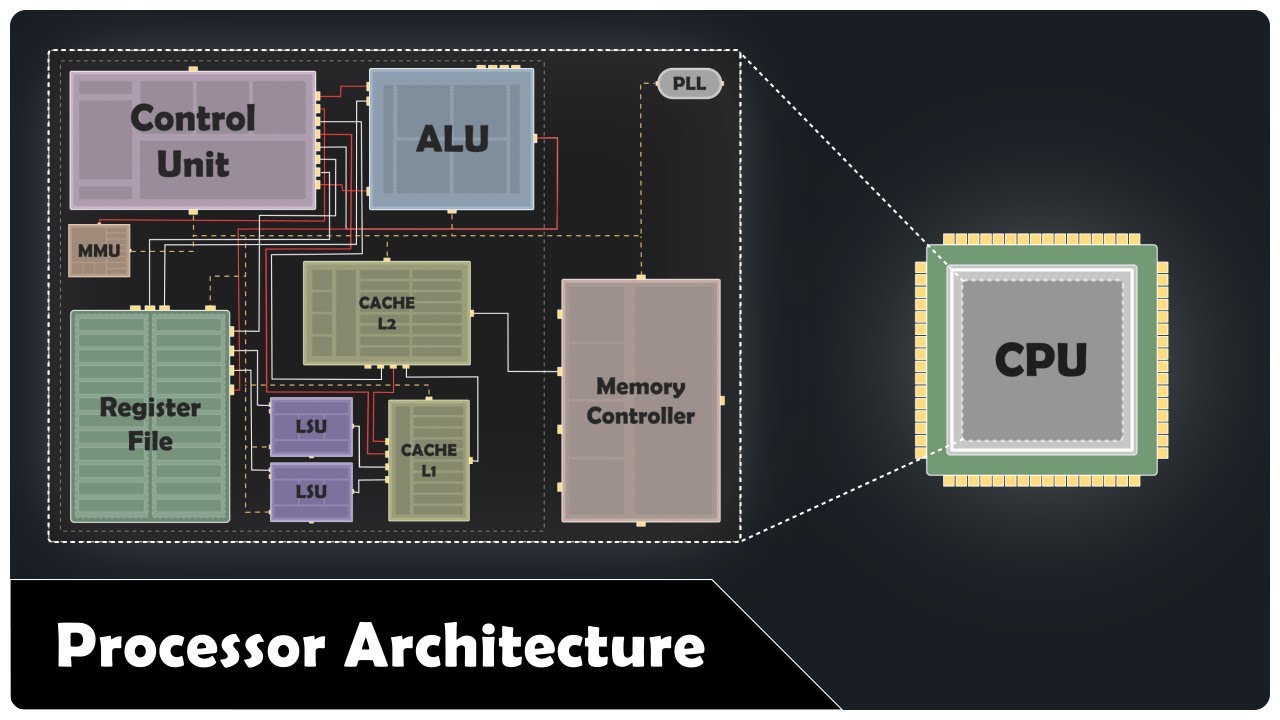
This video discusses the building blocks of a simple CPU, how they work individually, and how they cooperate to execute a set of instructions, which ultimatelly make any computer software run.
SUMMARY
To understand how CPU's work at the most fundamental level, we need to be familiar with it's most basic components, these are:
• The Arithmetic Logic Unit (ALU): the processor’s computational engine, responsible for executing arithmetic, logical, comparison, and shift operations.
• The Registers: a set of small, high-speed memory units, which are mainly found in the Register File, the Vector register block, and the Control Unit. Registers are used for temporarily holding data and instructions that are being actively used by other components, and are generally grouped into three types: General-Purpose, Special-Purpose, and Vector Registers.
• The Load/Store Unit: manages data transfers between the processor’s register file and external memory.
• Control Unit: fetches instructions from memory, decodes, and executes them, while managing all the other components.
Aside from these components, the processor also contains several subsystems that manage memory and data, maintain security, and improve system performance (the Memory Management Unit, Caches, and Memory Controller).
These components work together to execute a program through a continuous process called the Instruction Cycle. A classic instruction cycle includes 5 main stages:
• Fetch: Bringing the next instruction from memory into the processor's registers.
• Decode: Break the instruction down to its most basic components and generate signals for other components to prepare them for the execution of this specific instruction.
• Execute: The instruction is executed by the appropriate component(s).
• Memory: Data is loaded from or stored into memory.
• Write-Back: The result of the instruction is stored.
LINKS
📚 Computer Memory and Architecture E-Book Collection: https://bitlemon.lemonsqueezy.com/checkout/buy/d745ce58-0642-4dcd-8058-f5634a2b48a7?utm_source=youtube&utm_medium=video&utm_campaign=cpu-architecture
📚 BitLemon Store: https://bitlemon.lemonsqueezy.com?utm_source=youtube&utm_medium=video&utm_campaign=cpu-architecture
SOURCES
The information in this video is based on my book: Inside the Core: How the CPU Works.
TABLE OF CONTENTS
00:00 Introduction
00:21 Overview of the Instruction Cycle and ISAs
01:16 Processor Internal Components
04:15 Clock and Buses
05:04 Stages of the Instruction Cycle
07:12 Additional Material
#computerscience #cpu #processor #instructions #computerarchitecture
This video discusses the building blocks of a simple CPU, how they work individually, and how they cooperate to execute a set of instructions, which ultimatelly make any computer software run.
SUMMARY
To understand how CPU's work at the most fundamental level, we need to be familiar with it's most basic components, these are:
• The Arithmetic Logic Unit (ALU): the processor’s computational engine, responsible for executing arithmetic, logical, comparison, and shift operations.
• The Registers: a set of small, high-speed memory units, which are mainly found in the Register File, the Vector register block, and the Control Unit. Registers are used for temporarily holding data and instructions that are being actively used by other components, and are generally grouped into three types: General-Purpose, Special-Purpose, and Vector Registers.
• The Load/Store Unit: manages data transfers between the processor’s register file and external memory.
• Control Unit: fetches instructions from memory, decodes, and executes them, while managing all the other components.
Aside from these components, the processor also contains several subsystems that manage memory and data, maintain security, and improve system performance (the Memory Management Unit, Caches, and Memory Controller).
These components work together to execute a program through a continuous process called the Instruction Cycle. A classic instruction cycle includes 5 main stages:
• Fetch: Bringing the next instruction from memory into the processor's registers.
• Decode: Break the instruction down to its most basic components and generate signals for other components to prepare them for the execution of this specific instruction.
• Execute: The instruction is executed by the appropriate component(s).
• Memory: Data is loaded from or stored into memory.
• Write-Back: The result of the instruction is stored.
LINKS
📚 Computer Memory and Architecture E-Book Collection: https://bitlemon.lemonsqueezy.com/checkout/buy/d745ce58-0642-4dcd-8058-f5634a2b48a7?utm_source=youtube&utm_medium=video&utm_campaign=cpu-architecture
📚 BitLemon Store: https://bitlemon.lemonsqueezy.com?utm_source=youtube&utm_medium=video&utm_campaign=cpu-architecture
SOURCES
The information in this video is based on my book: Inside the Core: How the CPU Works.
TABLE OF CONTENTS
00:00 Introduction
00:21 Overview of the Instruction Cycle and ISAs
01:16 Processor Internal Components
04:15 Clock and Buses
05:04 Stages of the Instruction Cycle
07:12 Additional Material
#computerscience #cpu #processor #instructions #computerarchitecture
Tags and Topics
Browse our collection to discover more content in these categories.
Video Information
Views
155.6K
Likes
7.0K
Duration
7:38
Published
Nov 9, 2025
User Reviews
4.7
(31) Related Trending Topics
LIVE TRENDSRelated trending topics. Click any trend to explore more videos.
No specific trending topics match this video yet.
Explore All Trends