Henry Thomas or Ragtime Texas? 🎶
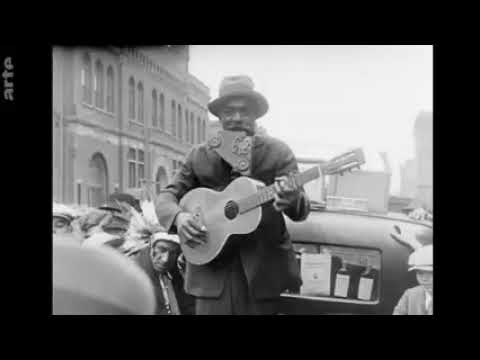
A 1931 silent film shows a musician at Maxwell Street market, possibly with the war-bonneted 'Indian'. Could it be Henry Thomas or Ragtime Texas?

BluesUrbano
9.3K views • Apr 22, 2021
About this video
- Courtesy of Axel Küstner, a 1931 silent film, at 56:30 there's a musician in Maxwell Street market, who is perhaps working with the war-bonneted 'Indian' as a medicine show (note the bottles in the car window, and the sign that seems to say 'Wizard Tonic.')” (Chris Smith).
- "Could this be Henry Thomas? If this were to be true, how glorious would it be?" (T. DeWayne Moore).
- There is a high likelihood that this is Henry Thomas. How many people played guitar and panpipes on a rack? (Here his panpipes are in some sort of decorated wooden or cardboard container.) He recorded in Chicago on four occasions between 1927 and 1929, which suggests that Chicago was his home or at least his "home base." He plays the guitar with a fast strumming technique, is capoed rather high up the neck (4th fret), and plays in G position of standard tuning, using his ring finger to alternate between the first and third strings at the third fret - all characteristics of Henry Thomas's playing. He appears to be around 50 years old, which would conform with what Mack McCormick reported about Thomas, though I myself have some degree of doubt that McCormick really identified the man. Anyway, just from the recorded repertoire and style, it's likely that Thomas was born in the 1880s if not earlier. I'm 99% certain it's Henry Thomas. Amazing! (David Evans)
- Well, THAT is amazing -- the guitar matching, the capo-position matching, the quills matching, the photos matching, the strum-tempo matching to his known songs, and he is known to have been in Chicago to record in 1929. The time is right, the place is right, and everything else fits too. It's Henry Thomas, sure as you're born! (Catherine Yronwood)
Full film "Weltstadt in Flegeljahren. Ein Bericht über Chicago" was available at www.arte.tv
From Wiki:
Henry Thomas (1874–1930?) was an American country blues singer, songster and musician. Although his recording career, in the late 1920s, was brief, Thomas influenced performers including Bob Dylan, Taj Mahal, The Lovin' Spoonful, The Grateful Dead, and Canned Heat. Often billed as "Ragtime Texas", his style is an early example of what became known as Texas blues guitar.
Thomas was born into a family of freed slaves in Big Sandy, Texas in 1874. He began traveling the Texas railroad lines as a hobo after leaving home in his teens. He eventually earned his way as an itinerant songster, entertaining local populaces as well as railway employees.
He recorded 24 sides for Vocalion between 1927 and 1929, 23 of which were released. They include reels, gospel songs, minstrel songs, ragtime numbers, and blues. Besides guitar, Thomas accompanied himself on quills, a folk instrument fabricated from cane reeds. His style of playing guitar was probably derived from banjo-picking styles.
His life and career after his last recordings in 1929 have not been chronicled. Although the blues researcher Mack McCormick stated that he saw a man in Houston in 1949 who met Thomas's description, most biographers indicate that Thomas died in 1930, when he would have been 55 or 56 years old.
Thomas's legacy has been sustained by his songs, which were revived by musicians beginning in the folk music revival of the early 1960s. Among the first of these was "Honey, Won't You Allow Me One More Chance", which was reinterpreted on The Freewheelin' Bob Dylan in 1963. Dylan may have been introduced to Thomas through Harry Smith's 1952 compilation Anthology of American Folk Music, which includes two of his songs, "Old Country Stomp" and "Fishing Blues". Dylan may have heard Thomas's song on the 1962 album Henry Thomas Sings the Texas Blues. He reworked the melody and almost totally rewrote the lyrics, but he credited Thomas as co-writer.
"Fishing Blues" was recorded by the folk-rock group the Lovin' Spoonful in 1965, for their hit debut album Do You Believe in Magic. The song was recorded two years later by Jim Kweskin, who had been playing it for several years. It was a staple in the early set-lists of the blues musician Taj Mahal and appeared on one of his first albums, De Old Folks at Home. John Martyn included the song on his 1968 album The Tumbler. The Nitty Gritty Dirt Band also covered the song on their album Will the Circle Be Unbroken, Volume III in 2002.
"Bull-Doze Blues", another of Thomas's Vocalion recordings, was reworked by the pianist Johnny Miller in 1927, who rewrote the words and gave it to Wingy Manone, who recorded two versions titled "Up the Country" in December 1927 for Columbia and September 1930 for Champion Records. Except in jazz circles, it remained an obscure blues number until blues-rock group Canned Heat recorded "Going Up the Country". Though rearranged, the Canned Heat song is musically the same, down to a faithful rendition of Thomas's quill solos by Jim Horn.
In 1966, the Lovin' Spoonful included an original song entitled "Henry Thomas" on their album Hums of the Lovin' Spoonful.
- "Could this be Henry Thomas? If this were to be true, how glorious would it be?" (T. DeWayne Moore).
- There is a high likelihood that this is Henry Thomas. How many people played guitar and panpipes on a rack? (Here his panpipes are in some sort of decorated wooden or cardboard container.) He recorded in Chicago on four occasions between 1927 and 1929, which suggests that Chicago was his home or at least his "home base." He plays the guitar with a fast strumming technique, is capoed rather high up the neck (4th fret), and plays in G position of standard tuning, using his ring finger to alternate between the first and third strings at the third fret - all characteristics of Henry Thomas's playing. He appears to be around 50 years old, which would conform with what Mack McCormick reported about Thomas, though I myself have some degree of doubt that McCormick really identified the man. Anyway, just from the recorded repertoire and style, it's likely that Thomas was born in the 1880s if not earlier. I'm 99% certain it's Henry Thomas. Amazing! (David Evans)
- Well, THAT is amazing -- the guitar matching, the capo-position matching, the quills matching, the photos matching, the strum-tempo matching to his known songs, and he is known to have been in Chicago to record in 1929. The time is right, the place is right, and everything else fits too. It's Henry Thomas, sure as you're born! (Catherine Yronwood)
Full film "Weltstadt in Flegeljahren. Ein Bericht über Chicago" was available at www.arte.tv
From Wiki:
Henry Thomas (1874–1930?) was an American country blues singer, songster and musician. Although his recording career, in the late 1920s, was brief, Thomas influenced performers including Bob Dylan, Taj Mahal, The Lovin' Spoonful, The Grateful Dead, and Canned Heat. Often billed as "Ragtime Texas", his style is an early example of what became known as Texas blues guitar.
Thomas was born into a family of freed slaves in Big Sandy, Texas in 1874. He began traveling the Texas railroad lines as a hobo after leaving home in his teens. He eventually earned his way as an itinerant songster, entertaining local populaces as well as railway employees.
He recorded 24 sides for Vocalion between 1927 and 1929, 23 of which were released. They include reels, gospel songs, minstrel songs, ragtime numbers, and blues. Besides guitar, Thomas accompanied himself on quills, a folk instrument fabricated from cane reeds. His style of playing guitar was probably derived from banjo-picking styles.
His life and career after his last recordings in 1929 have not been chronicled. Although the blues researcher Mack McCormick stated that he saw a man in Houston in 1949 who met Thomas's description, most biographers indicate that Thomas died in 1930, when he would have been 55 or 56 years old.
Thomas's legacy has been sustained by his songs, which were revived by musicians beginning in the folk music revival of the early 1960s. Among the first of these was "Honey, Won't You Allow Me One More Chance", which was reinterpreted on The Freewheelin' Bob Dylan in 1963. Dylan may have been introduced to Thomas through Harry Smith's 1952 compilation Anthology of American Folk Music, which includes two of his songs, "Old Country Stomp" and "Fishing Blues". Dylan may have heard Thomas's song on the 1962 album Henry Thomas Sings the Texas Blues. He reworked the melody and almost totally rewrote the lyrics, but he credited Thomas as co-writer.
"Fishing Blues" was recorded by the folk-rock group the Lovin' Spoonful in 1965, for their hit debut album Do You Believe in Magic. The song was recorded two years later by Jim Kweskin, who had been playing it for several years. It was a staple in the early set-lists of the blues musician Taj Mahal and appeared on one of his first albums, De Old Folks at Home. John Martyn included the song on his 1968 album The Tumbler. The Nitty Gritty Dirt Band also covered the song on their album Will the Circle Be Unbroken, Volume III in 2002.
"Bull-Doze Blues", another of Thomas's Vocalion recordings, was reworked by the pianist Johnny Miller in 1927, who rewrote the words and gave it to Wingy Manone, who recorded two versions titled "Up the Country" in December 1927 for Columbia and September 1930 for Champion Records. Except in jazz circles, it remained an obscure blues number until blues-rock group Canned Heat recorded "Going Up the Country". Though rearranged, the Canned Heat song is musically the same, down to a faithful rendition of Thomas's quill solos by Jim Horn.
In 1966, the Lovin' Spoonful included an original song entitled "Henry Thomas" on their album Hums of the Lovin' Spoonful.
Tags and Topics
Browse our collection to discover more content in these categories.
Video Information
Views
9.3K
Likes
171
Duration
0:11
Published
Apr 22, 2021
User Reviews
4.6
(1) Related Trending Topics
LIVE TRENDSRelated trending topics. Click any trend to explore more videos.