Cosmic Size Comparison of Planets & Stars 🌌
Explore the real scale of planets and stars in our solar system with stunning 4D animations. A mesmerizing cosmic journey!

3D Info Comparison
2.0K views • Jun 9, 2023
About this video
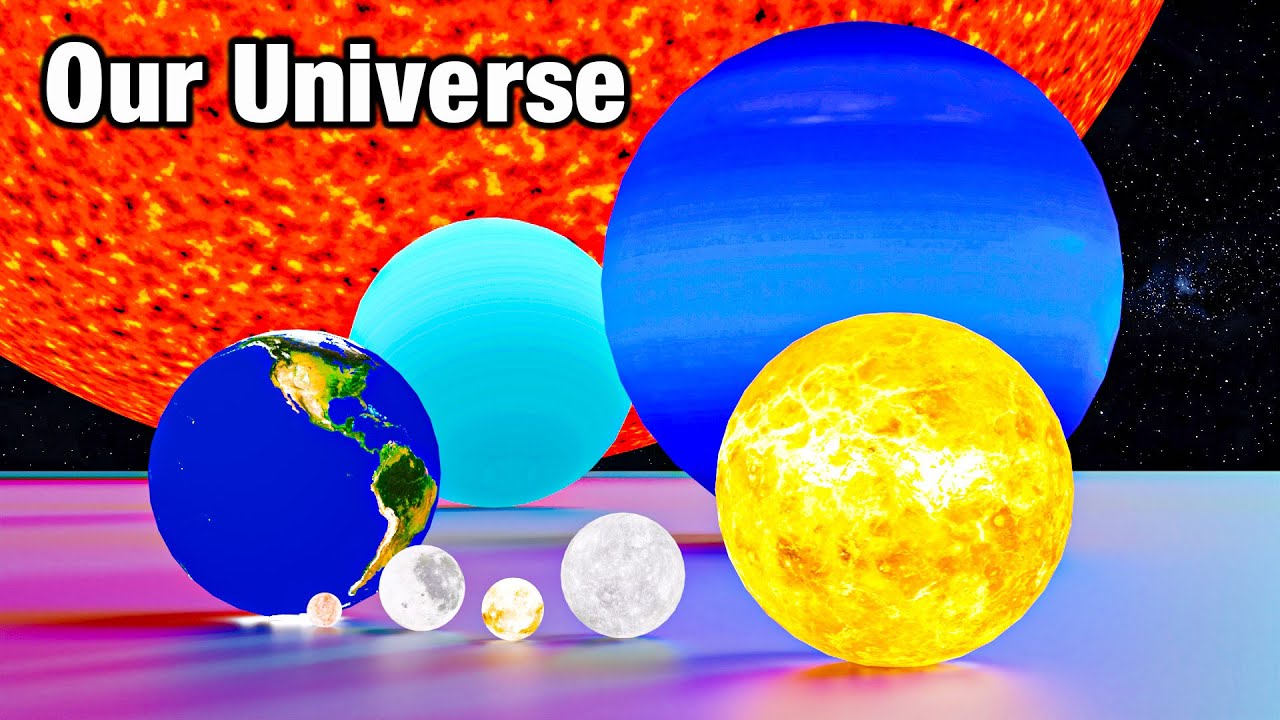
Cosmic Size Comparison | Planets & Stars Real Scale Comparison | 4D Animation Comparison
Our solar system is a mesmerizing place, a vast cosmic neighborhood that stretches billions of kilometers across. At its heart lies the radiant star we call the Sun, whose powerful gravitational pull governs the movements of the celestial bodies within its reach. Orbiting the Sun are eight planets, each with its own unique characteristics and mysteries waiting to be unraveled.
Starting with the innermost planet, Mercury, a scorching world bombarded by solar radiation, we venture out to Venus, Earth's inhospitable twin with a thick, toxic atmosphere. Then, we come across our home planet, Earth, a thriving oasis of life, teeming with diverse ecosystems and the only known abode of intelligent beings.
Further out, we encounter Mars, the red planet, with its dusty, barren landscapes and tantalizing clues about the possibility of past or present life. Then, the gas giants dominate the outer regions of our solar system. Jupiter, the giant of the planets, boasts a mesmerizing swirling atmosphere and a retinue of moons, including Europa, an icy world with a subsurface ocean that may harbor life.
Next, we have Saturn, known for its breathtaking rings that are composed of countless ice and rock particles. Uranus and Neptune, the ice giants, reside in the fringes, their atmospheres shrouded in mystery.
Beyond the confines of our solar system lie the nearest stars, like our Sun's close neighbors. Proxima Centauri, a mere 4.24 light-years away, is the closest known star to our solar system. It is part of the Alpha Centauri triple star system, alongside Alpha Centauri A and Alpha Centauri B. These stars, located about 4.37 light-years away, are the second closest to us.
Other nearby stars include Barnard's Star, Wolf 359, and Luhman 16. While they may appear relatively close in cosmic terms, the vast distances between stars make interstellar travel an immense challenge for humanity.
In this vast expanse of the cosmos, our solar system and its neighboring stars stand as a testament to the wonders of the universe. They inspire us to explore, to question, and to continue our quest for knowledge about the mysteries that lie beyond our celestial neighborhood.
If you like this video please like, comment, subscribe and share. Thanks for watching.
#Data_Comparison
#3DInfoComaprison
Our solar system is a mesmerizing place, a vast cosmic neighborhood that stretches billions of kilometers across. At its heart lies the radiant star we call the Sun, whose powerful gravitational pull governs the movements of the celestial bodies within its reach. Orbiting the Sun are eight planets, each with its own unique characteristics and mysteries waiting to be unraveled.
Starting with the innermost planet, Mercury, a scorching world bombarded by solar radiation, we venture out to Venus, Earth's inhospitable twin with a thick, toxic atmosphere. Then, we come across our home planet, Earth, a thriving oasis of life, teeming with diverse ecosystems and the only known abode of intelligent beings.
Further out, we encounter Mars, the red planet, with its dusty, barren landscapes and tantalizing clues about the possibility of past or present life. Then, the gas giants dominate the outer regions of our solar system. Jupiter, the giant of the planets, boasts a mesmerizing swirling atmosphere and a retinue of moons, including Europa, an icy world with a subsurface ocean that may harbor life.
Next, we have Saturn, known for its breathtaking rings that are composed of countless ice and rock particles. Uranus and Neptune, the ice giants, reside in the fringes, their atmospheres shrouded in mystery.
Beyond the confines of our solar system lie the nearest stars, like our Sun's close neighbors. Proxima Centauri, a mere 4.24 light-years away, is the closest known star to our solar system. It is part of the Alpha Centauri triple star system, alongside Alpha Centauri A and Alpha Centauri B. These stars, located about 4.37 light-years away, are the second closest to us.
Other nearby stars include Barnard's Star, Wolf 359, and Luhman 16. While they may appear relatively close in cosmic terms, the vast distances between stars make interstellar travel an immense challenge for humanity.
In this vast expanse of the cosmos, our solar system and its neighboring stars stand as a testament to the wonders of the universe. They inspire us to explore, to question, and to continue our quest for knowledge about the mysteries that lie beyond our celestial neighborhood.
If you like this video please like, comment, subscribe and share. Thanks for watching.
#Data_Comparison
#3DInfoComaprison
Tags and Topics
Browse our collection to discover more content in these categories.
Video Information
Views
2.0K
Likes
8
Duration
3:08
Published
Jun 9, 2023
User Reviews
3.9
(1) Related Trending Topics
LIVE TRENDSRelated trending topics. Click any trend to explore more videos.
No specific trending topics match this video yet.
Explore All Trends