Chris Peikert Explains Lattice Cryptography for Secure Internet Communication 🔐
Discover how Chris Peikert from Georgia Tech discusses the role of lattice cryptography in enhancing internet security at the 2014 PQCrypto conference.

Institute for Quantum Computing
4.3K views • Oct 23, 2014
About this video
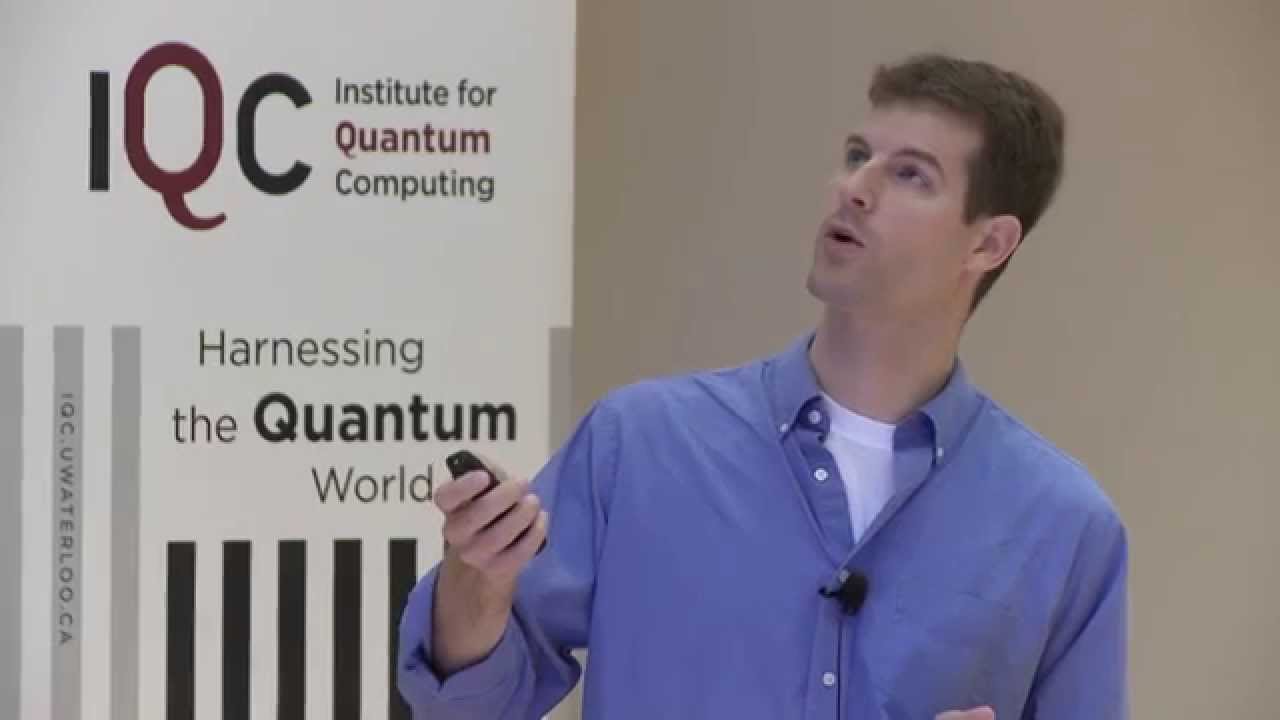
Chris Peikert of Georgia Institute of Technology presented a talk titled: Lattice cryptography for the internet at the 2014 PQCrypto conference in October, 2014.
Abstract: In recent years, lattice-based cryptography has been recognized for its many attractive properties, such as strong provable security guarantees and apparent resistance to quantum attacks, flexibility for realizing powerful tools like fully homomorphic encryption, and high asymptotic efficiency. Indeed, several works have demonstrated that for basic tasks like encryption and authentication, lattice-based primitives can have performance competitive with (or even surpassing) those based on classical mechanisms like RSA or Diffie-Hellman. However, there still has been relatively little work on developing lattice cryptography for deployment in real-world cryptosystems and protocols.
In this work, we take a step toward that goal, by giving efficient and practical lattice-based protocols for key transport, encryption, and authenticated key exchange that are suitable as "drop-in" components for proposed Internet standards and other open protocols. The security of all our proposals is provable based (sometimes in the random-oracle model) on the well-studied "leaning with errors over rings" problem, and hence on the conjectured worst-case hardness of problems on ideal lattices (against quantum algorithms).
One of our main technical innovations (which may be of independent interest) is a simple, low-bandwidth reconciliation technique that allows two parties who "approximately agree" on a secret value to reach exact agreement, a setting common to essentially all lattice-bases encryption schemes. Our technique reduces the ciphertext length of prior (already compact) encryption schemes nearly twofold, at essentially no cost.
PQCrypto
2014 Book: http://www.springer.com/computer/security+and+cryptology/book/978-3-319-11658-7
Workshop: https://pqcrypto2014.uwaterloo.ca/
Find out more about IQC!
Website - https://uwaterloo.ca/institute-for-qu...
Facebook - https://www.facebook.com/QuantumIQC
Twitter - https://twitter.com/QuantumIQC
Abstract: In recent years, lattice-based cryptography has been recognized for its many attractive properties, such as strong provable security guarantees and apparent resistance to quantum attacks, flexibility for realizing powerful tools like fully homomorphic encryption, and high asymptotic efficiency. Indeed, several works have demonstrated that for basic tasks like encryption and authentication, lattice-based primitives can have performance competitive with (or even surpassing) those based on classical mechanisms like RSA or Diffie-Hellman. However, there still has been relatively little work on developing lattice cryptography for deployment in real-world cryptosystems and protocols.
In this work, we take a step toward that goal, by giving efficient and practical lattice-based protocols for key transport, encryption, and authenticated key exchange that are suitable as "drop-in" components for proposed Internet standards and other open protocols. The security of all our proposals is provable based (sometimes in the random-oracle model) on the well-studied "leaning with errors over rings" problem, and hence on the conjectured worst-case hardness of problems on ideal lattices (against quantum algorithms).
One of our main technical innovations (which may be of independent interest) is a simple, low-bandwidth reconciliation technique that allows two parties who "approximately agree" on a secret value to reach exact agreement, a setting common to essentially all lattice-bases encryption schemes. Our technique reduces the ciphertext length of prior (already compact) encryption schemes nearly twofold, at essentially no cost.
PQCrypto
2014 Book: http://www.springer.com/computer/security+and+cryptology/book/978-3-319-11658-7
Workshop: https://pqcrypto2014.uwaterloo.ca/
Find out more about IQC!
Website - https://uwaterloo.ca/institute-for-qu...
Facebook - https://www.facebook.com/QuantumIQC
Twitter - https://twitter.com/QuantumIQC
Tags and Topics
Browse our collection to discover more content in these categories.
Video Information
Views
4.3K
Likes
37
Duration
24:58
Published
Oct 23, 2014
User Reviews
4.2
(4) Related Trending Topics
LIVE TRENDSRelated trending topics. Click any trend to explore more videos.
No specific trending topics match this video yet.
Explore All Trends