CENTA Webinar: Sanskrit Mathematics & Modern Syllabus 📚
Explore the link between ancient Indian mathematics from Sanskrit texts and today's high school curriculum in this CENTA session.

CENTA Team
1.8K views • Oct 8, 2020
About this video
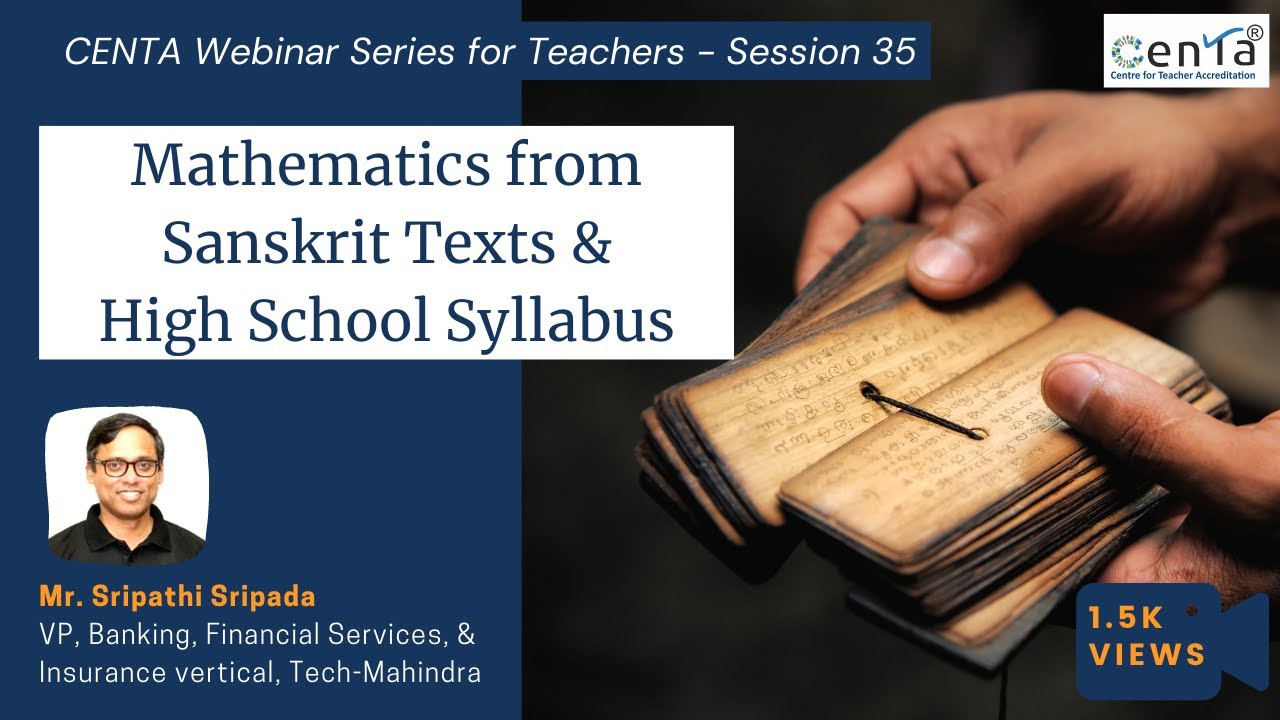
This session is focused on the relevance of Indian Mathematics from Sanskrit texts to the contemporary high school syllabus. It was facilitated by Mr. Sripathi Sripada, the VP of the Banking, Financial Services, and Insurance vertical of Tech-Mahindra who is quite passionate about Indian scriptures.
The innovation of India's numerical writings is an outcome of the refined culture of the researchers who delivered them. A couple of models show unmistakably some notable highlights of the propensities for work and the strategies for considered antiquated and archaic Indian mathematicians. The mentality of the customary educated man, called "pandit", is the equivalent, regardless of whether he chips away at scholarly or specialized issue. Inclination to orality, utilization of memory, mind work are his particular characteristics. Creation in section structure, utilization of interchangeable words, figurative articulation, which are sudden cycles for the article of specialized issue, have been the standard in all the huge Sanskrit numerical writing. The current article investigations a procedure of retention of the content of the Vedas, the soonest composition of calculation rules with regards to Vedic customs of building block special raised areas, the numeration framework, the arithmetical and mathematical idea of square.
India's numerical writings are exceptionally unique in more than one manner: in addition to the fact that they embody unique examination strategies, they additionally rise out of a refined culture with which each researcher was profoundly saturated. At the point when one analyzes a Sanskrit logical content, it is legitimate not to fail to remember the Indian climate of the creator, regardless of whether the substance of his work comprise of positive information existing additionally in different developments simultaneously. The reason for this article is to cause to notice the scholarly foundation of old and middle age mathematicians. A notable component is that in old occasions they seem to have been working in a climate of unadulterated orality with unique scholarly exercises, retention and so on In the period that followed they worked in a climate where the propensities for orality were kept up and the instrument of composing was utilized. We will consider quickly these scholarly propensities and give a couple of instances of numerical pieces. Indian mathematicians of old and early middle age periods whose works have come down to us can be characterized as Sanskrit pandits (skillet. d. ita "realized man").1 What this implies is that they went through an escalated preparing in taking care of Sanskrit language, scholarly creation and in rehearsing a few scholarly trains managing language, writing and thinking. Whatever might be his uncommon field, each pandit has a typical load of information in language structure (vyakaran ¯ . a), interpretation (m¯ımam¯ . sa¯) and rationale (nyaya ¯ ). On account of that, he is blessed with a sharp phonetic mindfulness, furnished with a rich store of likely assets of articulation, and has available to him various heuristic apparatuses. Furthermore the pandit's schooling targets improving the regular resources of discourse and memory.
The innovation of India's numerical writings is an outcome of the refined culture of the researchers who delivered them. A couple of models show unmistakably some notable highlights of the propensities for work and the strategies for considered antiquated and archaic Indian mathematicians. The mentality of the customary educated man, called "pandit", is the equivalent, regardless of whether he chips away at scholarly or specialized issue. Inclination to orality, utilization of memory, mind work are his particular characteristics. Creation in section structure, utilization of interchangeable words, figurative articulation, which are sudden cycles for the article of specialized issue, have been the standard in all the huge Sanskrit numerical writing. The current article investigations a procedure of retention of the content of the Vedas, the soonest composition of calculation rules with regards to Vedic customs of building block special raised areas, the numeration framework, the arithmetical and mathematical idea of square.
India's numerical writings are exceptionally unique in more than one manner: in addition to the fact that they embody unique examination strategies, they additionally rise out of a refined culture with which each researcher was profoundly saturated. At the point when one analyzes a Sanskrit logical content, it is legitimate not to fail to remember the Indian climate of the creator, regardless of whether the substance of his work comprise of positive information existing additionally in different developments simultaneously. The reason for this article is to cause to notice the scholarly foundation of old and middle age mathematicians. A notable component is that in old occasions they seem to have been working in a climate of unadulterated orality with unique scholarly exercises, retention and so on In the period that followed they worked in a climate where the propensities for orality were kept up and the instrument of composing was utilized. We will consider quickly these scholarly propensities and give a couple of instances of numerical pieces. Indian mathematicians of old and early middle age periods whose works have come down to us can be characterized as Sanskrit pandits (skillet. d. ita "realized man").1 What this implies is that they went through an escalated preparing in taking care of Sanskrit language, scholarly creation and in rehearsing a few scholarly trains managing language, writing and thinking. Whatever might be his uncommon field, each pandit has a typical load of information in language structure (vyakaran ¯ . a), interpretation (m¯ımam¯ . sa¯) and rationale (nyaya ¯ ). On account of that, he is blessed with a sharp phonetic mindfulness, furnished with a rich store of likely assets of articulation, and has available to him various heuristic apparatuses. Furthermore the pandit's schooling targets improving the regular resources of discourse and memory.
Video Information
Views
1.8K
Likes
133
Duration
01:11:53
Published
Oct 8, 2020
User Reviews
4.5
(1) Related Trending Topics
LIVE TRENDSRelated trending topics. Click any trend to explore more videos.
Trending Now