Can Complexity Theory Confirm the Power of the Market’s Invisible Hand? 🤔
Explore how complexity theory might validate Adam Smith's concept of the invisible hand and its implications for understanding market dynamics in this insightful lecture by Vijay Vazirani.

Institute for Advanced Study
318 views • Sep 1, 2016
About this video
Vijay Vazirani
Georgia Institute of Technology
April 19, 2010
*It is not from the benevolence of the butcher, the brewer, or the baker, that we expect our dinner, but from their regard for their own interest. Each participant in a competitive economy is led by an invisible hand to promote an end which was no part of his intention.*
Adam Smith, 1776
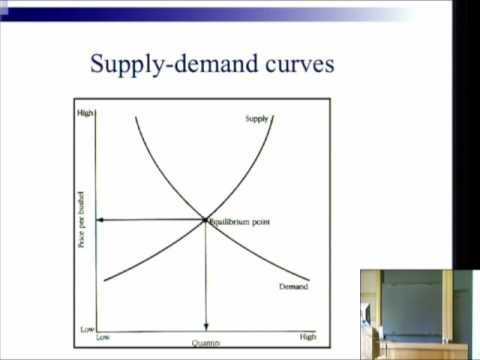
With his treatise, *The Wealth of Nations*, 1776, Adam Smith initiated the field of economics, and his famous quote provided this field with its central guiding principle. The pioneering work of Walras (1874) gave a mathematical formulation for this statement, using his notion of market equilibrium, and opened up the possibility of a formal ratification.
Mathematical ratification came with the celebrated Arrow-Debreu Theorem (1954), which established existence of equilibrium in a very general model of the economy; however, an efficient mechanism for finding an equilibrium has remained elusive.
The question of algorithmic ratification was taken up in the earnest within theoretical computer science a decade ago, and attention soon gravitated on markets under piecewise-linear, concave utility functions. As it turned out, the recent resolution of this open problem did not yield the hoped-for mechanism; however, it did mark the end of the road for the current approach. It is now time to step back and plan a fresh attack, using the powerful tools of modern complexity theory and algorithms.
After providing a summary of key developments through the ages and a gist of the recent results, we will discuss some ways of moving forward.
(Based in part on recent work with Mihalis Yannakakis.)
For more videos, visit http://video.ias.edu
Georgia Institute of Technology
April 19, 2010
*It is not from the benevolence of the butcher, the brewer, or the baker, that we expect our dinner, but from their regard for their own interest. Each participant in a competitive economy is led by an invisible hand to promote an end which was no part of his intention.*
Adam Smith, 1776
With his treatise, *The Wealth of Nations*, 1776, Adam Smith initiated the field of economics, and his famous quote provided this field with its central guiding principle. The pioneering work of Walras (1874) gave a mathematical formulation for this statement, using his notion of market equilibrium, and opened up the possibility of a formal ratification.
Mathematical ratification came with the celebrated Arrow-Debreu Theorem (1954), which established existence of equilibrium in a very general model of the economy; however, an efficient mechanism for finding an equilibrium has remained elusive.
The question of algorithmic ratification was taken up in the earnest within theoretical computer science a decade ago, and attention soon gravitated on markets under piecewise-linear, concave utility functions. As it turned out, the recent resolution of this open problem did not yield the hoped-for mechanism; however, it did mark the end of the road for the current approach. It is now time to step back and plan a fresh attack, using the powerful tools of modern complexity theory and algorithms.
After providing a summary of key developments through the ages and a gist of the recent results, we will discuss some ways of moving forward.
(Based in part on recent work with Mihalis Yannakakis.)
For more videos, visit http://video.ias.edu
Video Information
Views
318
Likes
7
Duration
01:13:23
Published
Sep 1, 2016
Related Trending Topics
LIVE TRENDSRelated trending topics. Click any trend to explore more videos.
No specific trending topics match this video yet.
Explore All Trends