CAM Colloquium - Noah Stephens Davidowitz
Exploring the revolution in cryptography through lattice-based constructions.

CAM - Cornell Center for Applied Math Colloquium
137 views • May 18, 2021
About this video
Abstract:
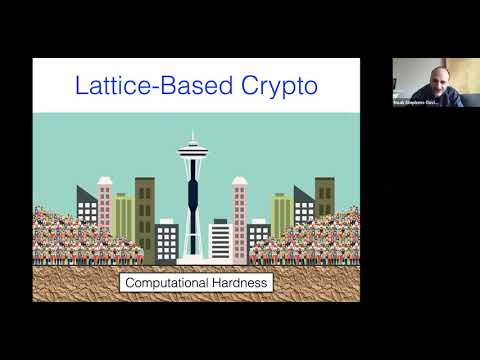
There has been a recent revolution in cryptography due to the introduction of lattice-based constructions. These are cryptographic schemes whose security relies on the presumed hardness of certain computational problems over ubiquitous (and beautiful) geometric objects called lattices. Their many applications (e.g., fully homomorphic encryption) and presumed security against adversaries with quantum computers has created some urgency to deploy lattice-based schemes widely over the next few years. For example, the National Institute of Standards and Technology is in the process of standardizing lattice-based cryptography, and Google has already implemented such a scheme in its Canary browser.
The security of the proposed schemes relies crucially on the assumption that our current best algorithms (both classical and quantum) for the relevant computational lattice problems cannot be improved by even a relatively small amount. I will discuss the state of the art in the study of this assumption. In particular, I will describe the fastest known algorithms for these problems (and potential directions to improve them) as well as a recent series of hardness results that use the tools of fine-grained complexity to provide strong evidence for the security of lattice-based cryptography.
Bio:
Noah Stephens-Davidowitz is a newly minted assistant professor in Cornell's computer science department. Before this, he was a postdoc at the Simons Institute in Berkeley. He has also been a postdoc at MIT, Princeton, and at the Institute for Advanced Study. He received his PhD from NYU, advised by Yevgeniy Dodis and Oded Regev. Much of Noah’s research uses the tools of theoretical computer science to answer fundamental questions about the security of widely deployed real-world cryptography, particularly post-quantum lattice-based cryptography. He is also interested more broadly in theoretical computer science, cryptography, and geometry.
There has been a recent revolution in cryptography due to the introduction of lattice-based constructions. These are cryptographic schemes whose security relies on the presumed hardness of certain computational problems over ubiquitous (and beautiful) geometric objects called lattices. Their many applications (e.g., fully homomorphic encryption) and presumed security against adversaries with quantum computers has created some urgency to deploy lattice-based schemes widely over the next few years. For example, the National Institute of Standards and Technology is in the process of standardizing lattice-based cryptography, and Google has already implemented such a scheme in its Canary browser.
The security of the proposed schemes relies crucially on the assumption that our current best algorithms (both classical and quantum) for the relevant computational lattice problems cannot be improved by even a relatively small amount. I will discuss the state of the art in the study of this assumption. In particular, I will describe the fastest known algorithms for these problems (and potential directions to improve them) as well as a recent series of hardness results that use the tools of fine-grained complexity to provide strong evidence for the security of lattice-based cryptography.
Bio:
Noah Stephens-Davidowitz is a newly minted assistant professor in Cornell's computer science department. Before this, he was a postdoc at the Simons Institute in Berkeley. He has also been a postdoc at MIT, Princeton, and at the Institute for Advanced Study. He received his PhD from NYU, advised by Yevgeniy Dodis and Oded Regev. Much of Noah’s research uses the tools of theoretical computer science to answer fundamental questions about the security of widely deployed real-world cryptography, particularly post-quantum lattice-based cryptography. He is also interested more broadly in theoretical computer science, cryptography, and geometry.
Tags and Topics
Browse our collection to discover more content in these categories.
Video Information
Views
137
Likes
1
Duration
59:18
Published
May 18, 2021
Related Trending Topics
LIVE TRENDSRelated trending topics. Click any trend to explore more videos.
No specific trending topics match this video yet.
Explore All Trends