Big Oh(O) vs Big Omega(Ω) vs Big Theta(θ) notations | Asymptotic Analysis of Algorithms with Example
Support Simple Snippets by Donations - Google Pay UPI ID - tanmaysakpal11@okicici PayPal - paypal.me/tanmaysakpal11 -----------------------------------------...
Simple Snippets
230.4K views • Sep 4, 2019
About this video
Support Simple Snippets by Donations -
Google Pay UPI ID - tanmaysakpal11@okicici
PayPal - paypal.me/tanmaysakpal11
--------------------------------------------------------------------------------------------- In this tutorial we will understand the 3 different Asymptotic Time Complexity analysis of Algorithms namely -
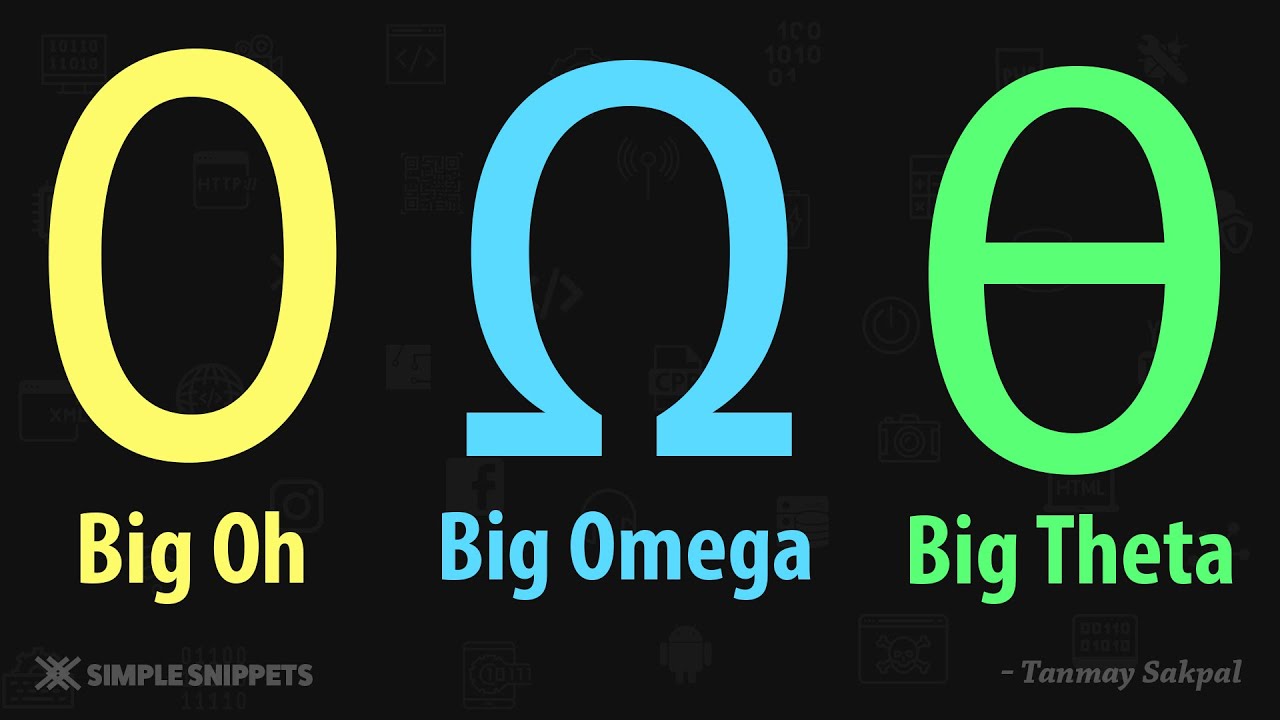
Big Oh(O)
Big Omega(Ω)
Big Theta(θ)
We will understand each Complexity by taking its mathematical definition as well as example with graph.
Lastly we will understand its practical usage & understand why we really need 3 different time complexity measures.
Big O notation -
Big O notation specifically describes worst case scenario.
It represents the upper bound running time complexity of an algorithm.
Mathematically -
Let f and g be functions of n - where n is natural no denoting size or steps of the algorithm then -
f(n) = O(g(n))
IFF
f(n) less than or = c.g(n)
where n greater than = n0, c greater than 0, n0 greater than = 1
Big Omega notation -
Big Omega notation specifically describes best case scenario.
It represents the lower bound running time complexity of an algorithm.
Basically it tells you what is the fastest time/behavior in which the algorithm can run.
f(n) = Ω(g(n))
IFF
f(n) greater than or = c.g(n)
where n greater than = n0, c greater than 0, n0 greater than = 1
Big Theta (θ) notation -
Big Omega notation specifically describes average case scenario.
It represents the most realistic time complexity of an algorithm.
f(n) = θ(g(n))
IFF
c1.g(n) less than or = f(n) less than or = c2.g(n)
where n greater than = n0, c1,c2 greater than 0, n greater than = n0, n0 greater = 1
Big Ω - Best Case
Big O - Worst Case
Big θ - Average Case
Simple Snippets Official Website -
http://simplesnippets.tech/
Simple Snippets on Facebook -
https://www.facebook.com/simplesnippets/
Simple Snippets on Instagram -
https://www.instagram.com/simplesnippets/
Simple Snippets on Twitter -
https://twitter.com/simplesnippet
Simple Snippets Google Plus Page -
https://plus.google.com/+SimpleSnippets
Simple Snippets email ID -
simplesnippetsinfo@gmail.com
For More Technology News, Latest Updates and Blog articles visit our Official Website - http://simplesnippets.tech/
Google Pay UPI ID - tanmaysakpal11@okicici
PayPal - paypal.me/tanmaysakpal11
--------------------------------------------------------------------------------------------- In this tutorial we will understand the 3 different Asymptotic Time Complexity analysis of Algorithms namely -
Big Oh(O)
Big Omega(Ω)
Big Theta(θ)
We will understand each Complexity by taking its mathematical definition as well as example with graph.
Lastly we will understand its practical usage & understand why we really need 3 different time complexity measures.
Big O notation -
Big O notation specifically describes worst case scenario.
It represents the upper bound running time complexity of an algorithm.
Mathematically -
Let f and g be functions of n - where n is natural no denoting size or steps of the algorithm then -
f(n) = O(g(n))
IFF
f(n) less than or = c.g(n)
where n greater than = n0, c greater than 0, n0 greater than = 1
Big Omega notation -
Big Omega notation specifically describes best case scenario.
It represents the lower bound running time complexity of an algorithm.
Basically it tells you what is the fastest time/behavior in which the algorithm can run.
f(n) = Ω(g(n))
IFF
f(n) greater than or = c.g(n)
where n greater than = n0, c greater than 0, n0 greater than = 1
Big Theta (θ) notation -
Big Omega notation specifically describes average case scenario.
It represents the most realistic time complexity of an algorithm.
f(n) = θ(g(n))
IFF
c1.g(n) less than or = f(n) less than or = c2.g(n)
where n greater than = n0, c1,c2 greater than 0, n greater than = n0, n0 greater = 1
Big Ω - Best Case
Big O - Worst Case
Big θ - Average Case
Simple Snippets Official Website -
http://simplesnippets.tech/
Simple Snippets on Facebook -
https://www.facebook.com/simplesnippets/
Simple Snippets on Instagram -
https://www.instagram.com/simplesnippets/
Simple Snippets on Twitter -
https://twitter.com/simplesnippet
Simple Snippets Google Plus Page -
https://plus.google.com/+SimpleSnippets
Simple Snippets email ID -
simplesnippetsinfo@gmail.com
For More Technology News, Latest Updates and Blog articles visit our Official Website - http://simplesnippets.tech/
Tags and Topics
Browse our collection to discover more content in these categories.
Video Information
Views
230.4K
Likes
5.2K
Duration
28:50
Published
Sep 4, 2019
User Reviews
4.7
(46) Related Trending Topics
LIVE TRENDSRelated trending topics. Click any trend to explore more videos.
No specific trending topics match this video yet.
Explore All Trends