Big Data, Information, and Ethical Issues in Artificial Reasoning - Course 8
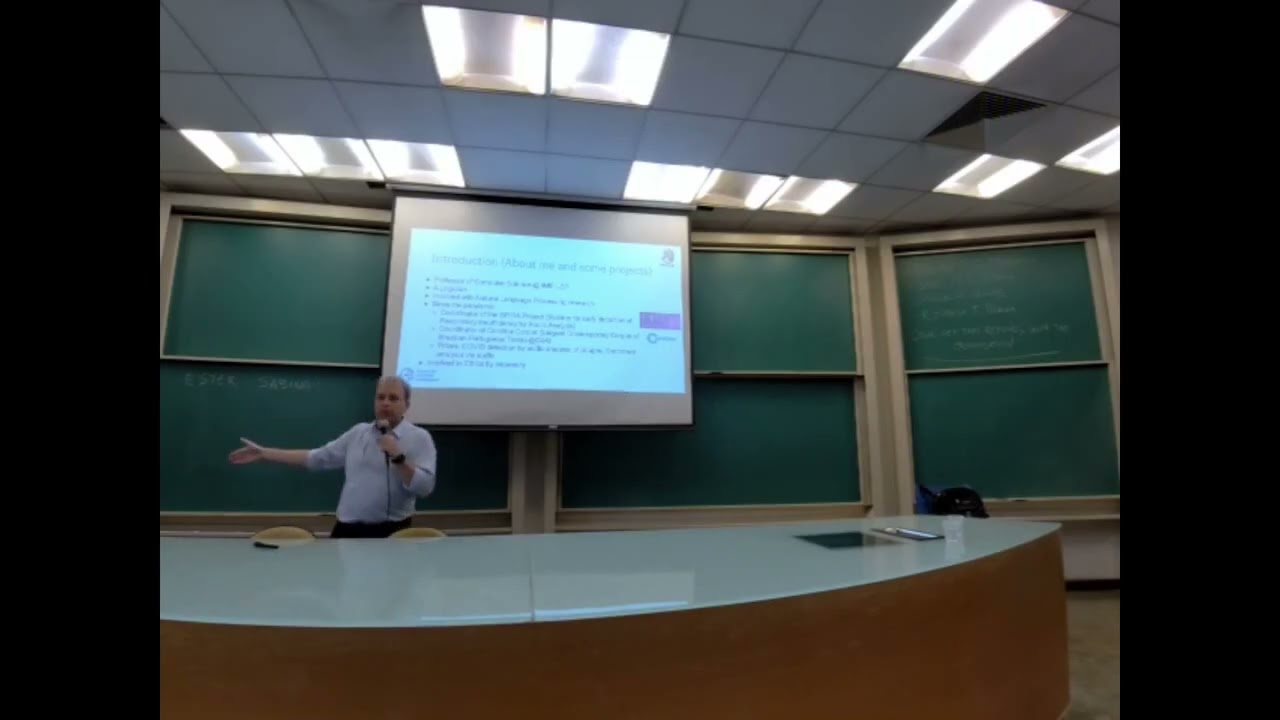
Presented by Maria Eunice Quilici Gonzalez from CLE/São Paulo State University – Unesp, Brazil, this course explores the intersection of big data, information management, and the ethical challenges posed by artificial reasoning. Date: February 15th, 2023,
Centro de Lógica, Epistemologia CLE/UNICAMP
10 views • Aug 13, 2025
About this video
Big Data, Information, and Ethical Issues in Artificial Reasoning (Course 8)
Maria Eunice Quilici Gonzalez (CLE/São Paulo State University – Unesp, Brazil)
Marcelo Finger (USP – University of São Paulo, Computer Science Department)
Abstract: In our lectures, we will present, initially, topics of information theory grounded on the hypotheses of (a) Shannon & Weaver’s Mathematical Theory of Communication; (b) Dretske’s Knowledge and the Flow of Information; (c) Peirce’s semiotic approach to information; and (d) principles of information processing in complex decentralized systems, proposed by Mitchell in her paper: “Complex Systems: Network Thinking”. In the second part of the lectures, emphasis is going to be given to considerations on ethical issues related to uses of Big Data analysis and Artificial Intelligence modelling in contemporary science. We will approach ethical requirements from the point of view of program developers and researchers working at the forefront of the area of Deep Neural Network (DNN) and Big Data (BD). A brief history of the co-evolution of these two techniques are going to be presented. In this context, we will discuss the requirements and ethical issues that emerge from the use of massive data in science, and the ethical challenges that need to be faced by researchers and programmers on the front lines of new technology development. Finally, we are going to introduce a vision of how modern research in Logic can interact with the areas of Big Data and deep neural networks processing (Deep Learning). Issues such as computational complexity of inferential processing will be discussed, with emphasis on the importance of Complexity Theory as a contribution of the computing area to the History of Thought, and the difficulties/possibilities of modern logic in dealing with information containing noise, as well as logic reasoning that is tolerant to approximations.
Maria Eunice Quilici Gonzalez (CLE/São Paulo State University – Unesp, Brazil)
Marcelo Finger (USP – University of São Paulo, Computer Science Department)
Abstract: In our lectures, we will present, initially, topics of information theory grounded on the hypotheses of (a) Shannon & Weaver’s Mathematical Theory of Communication; (b) Dretske’s Knowledge and the Flow of Information; (c) Peirce’s semiotic approach to information; and (d) principles of information processing in complex decentralized systems, proposed by Mitchell in her paper: “Complex Systems: Network Thinking”. In the second part of the lectures, emphasis is going to be given to considerations on ethical issues related to uses of Big Data analysis and Artificial Intelligence modelling in contemporary science. We will approach ethical requirements from the point of view of program developers and researchers working at the forefront of the area of Deep Neural Network (DNN) and Big Data (BD). A brief history of the co-evolution of these two techniques are going to be presented. In this context, we will discuss the requirements and ethical issues that emerge from the use of massive data in science, and the ethical challenges that need to be faced by researchers and programmers on the front lines of new technology development. Finally, we are going to introduce a vision of how modern research in Logic can interact with the areas of Big Data and deep neural networks processing (Deep Learning). Issues such as computational complexity of inferential processing will be discussed, with emphasis on the importance of Complexity Theory as a contribution of the computing area to the History of Thought, and the difficulties/possibilities of modern logic in dealing with information containing noise, as well as logic reasoning that is tolerant to approximations.
Tags and Topics
Browse our collection to discover more content in these categories.
Video Information
Views
10
Likes
1
Duration
01:45:15
Published
Aug 13, 2025
Related Trending Topics
LIVE TRENDSRelated trending topics. Click any trend to explore more videos.
No specific trending topics match this video yet.
Explore All Trends