Avi Wigderson Explores the Power of Randomness in Computational Complexity 🌐
Discover insights from Avi Wigderson's 2008 ISIT plenary talk on how randomness influences computational complexity and problem-solving in computer science.
IEEE Information Theory Society
654 views • May 4, 2017
About this video
2008 ISIT Plenary Talk
Randomness - A Computational Complexity View
Professor Avi Wigderson
Institute for Advanced Study
Princeton University
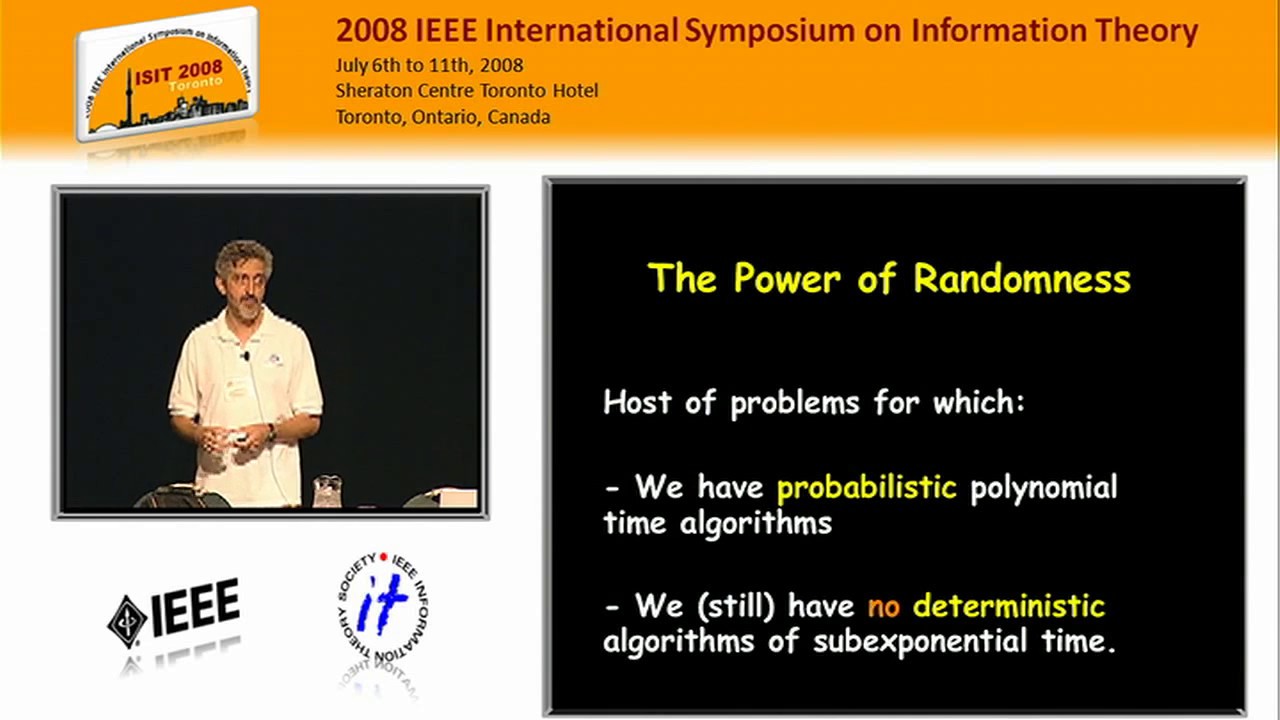
Man has grappled with the meaning and utility of randomness for centuries. Research in the Theory of Computation in the last thirty years has enriched this study considerably. I'll describe two main aspects of this research on randomness, demonstrating its power and weakness respectively.
-Randomness is paramount to computational efficiency:
The use of randomness can dramatically enhance computation (and do other wonders) for a variety of problems and settings. In particular, examples will be given of probabilistic algorithms (with tiny error) for natural tasks in different areas of mathematics, which are exponentially faster than their (best known) deterministic counterparts.
-Computational efficiency is paramount to understanding randomness:
I will explain the computationally-motivated definition of "pseudorandom" distributions, namely ones which cannot be distinguished from the uniform distribution by efficient procedure from a given class. We then show how such pseudorandomness may be generated deterministically, from (appropriate) computationally difficult problems. Consequently, randomness is probably not as powerful as it seems above.
I'll conclude with the power of randomness in other computational settings, primarily probabilistic proof systems. We discuss the remarkable properties of Zero-Knowledge proofs and of Probabilistically Checkable proofs.
Randomness - A Computational Complexity View
Professor Avi Wigderson
Institute for Advanced Study
Princeton University
Man has grappled with the meaning and utility of randomness for centuries. Research in the Theory of Computation in the last thirty years has enriched this study considerably. I'll describe two main aspects of this research on randomness, demonstrating its power and weakness respectively.
-Randomness is paramount to computational efficiency:
The use of randomness can dramatically enhance computation (and do other wonders) for a variety of problems and settings. In particular, examples will be given of probabilistic algorithms (with tiny error) for natural tasks in different areas of mathematics, which are exponentially faster than their (best known) deterministic counterparts.
-Computational efficiency is paramount to understanding randomness:
I will explain the computationally-motivated definition of "pseudorandom" distributions, namely ones which cannot be distinguished from the uniform distribution by efficient procedure from a given class. We then show how such pseudorandomness may be generated deterministically, from (appropriate) computationally difficult problems. Consequently, randomness is probably not as powerful as it seems above.
I'll conclude with the power of randomness in other computational settings, primarily probabilistic proof systems. We discuss the remarkable properties of Zero-Knowledge proofs and of Probabilistically Checkable proofs.
Video Information
Views
654
Likes
9
Duration
55:43
Published
May 4, 2017
Related Trending Topics
LIVE TRENDSRelated trending topics. Click any trend to explore more videos.
No specific trending topics match this video yet.
Explore All Trends