Analyzing the Effects of Noise on Neural Computation
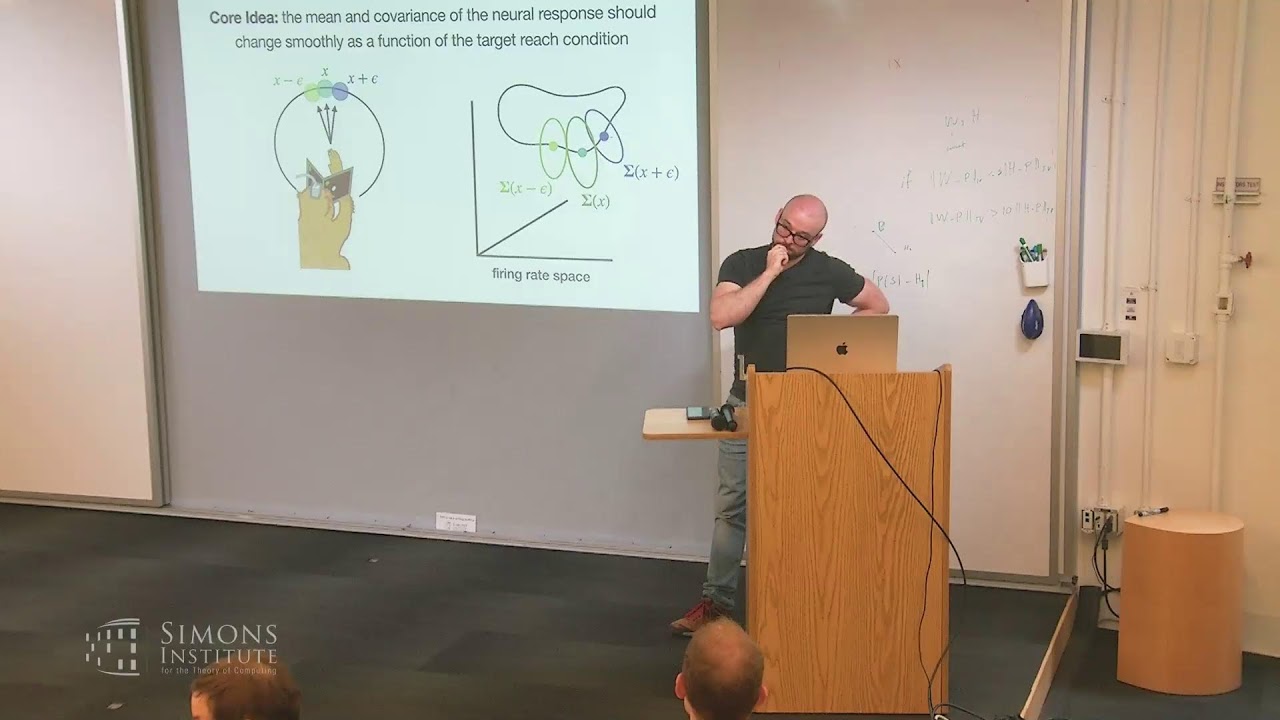
Alex Williams from NYU and the Flatiron Institute explores how noise influences neural computation, providing insights into lower-level intelligence processes. Presented at the Simons Institute on June 3, 2024.

Simons Institute for the Theory of Computing
574 views • Jun 18, 2024
About this video
Alex Williams (NYU, Flatiron Institute)
https://simons.berkeley.edu/talks/alex-williams-nyu-flatiron-institute-2024-06-03
Understanding Lower-Level Intelligence from AI; Psychology; and Neuroscience Perspectives
Noise is a ubiquitous property of biological neural circuits—trial-to-trial variance in neural spike counts is often equal or greater in magnitude to the mean neural response. Noise has also been incorporated into artificial neural networks; for example, as a form of regularization. But the detailed impact of noise on neural computations and hidden layer representations remains poorly understood. In neuroscience, a primary challenge has been to accurately estimate the statistics of noise with limited trials. To address this, we introduce a statistical model that leverages smoothness in experimental paradigms to derive efficient estimates of trial-to-trial noise covariance. Furthermore, to compare the structure of noise between artificial and biological networks, we propose a novel measure of neural representational similarity for stochastic networks. Together, these analytic tools enable new lines of investigation into non-deterministic modes of neural network function.
https://simons.berkeley.edu/talks/alex-williams-nyu-flatiron-institute-2024-06-03
Understanding Lower-Level Intelligence from AI; Psychology; and Neuroscience Perspectives
Noise is a ubiquitous property of biological neural circuits—trial-to-trial variance in neural spike counts is often equal or greater in magnitude to the mean neural response. Noise has also been incorporated into artificial neural networks; for example, as a form of regularization. But the detailed impact of noise on neural computations and hidden layer representations remains poorly understood. In neuroscience, a primary challenge has been to accurately estimate the statistics of noise with limited trials. To address this, we introduce a statistical model that leverages smoothness in experimental paradigms to derive efficient estimates of trial-to-trial noise covariance. Furthermore, to compare the structure of noise between artificial and biological networks, we propose a novel measure of neural representational similarity for stochastic networks. Together, these analytic tools enable new lines of investigation into non-deterministic modes of neural network function.
Tags and Topics
Browse our collection to discover more content in these categories.
Video Information
Views
574
Likes
10
Duration
32:38
Published
Jun 18, 2024
Related Trending Topics
LIVE TRENDSRelated trending topics. Click any trend to explore more videos.
Trending Now