Alan Turing: The Father of Computer Science & Key to Allied Victory in WWII 🧠
Discover how Alan Turing, a brilliant mathematician and cryptanalyst, played a crucial role in saving the Allies during WWII and laid the foundations of modern computing and AI.

Military History
212 views • Jul 5, 2023
About this video
Alan Mathison Turing was a British mathematician, computer scientist, logician, cryptanalyst, philosopher, and theoretical biologist.Turing was highly influential in the development of theoretical computer science, providing a formalisation of the concepts of algorithm and computation with the Turing machine, which can be considered a model of a general-purpose computer.He is widely considered to be the father of theoretical computer science and artificial intelligence.
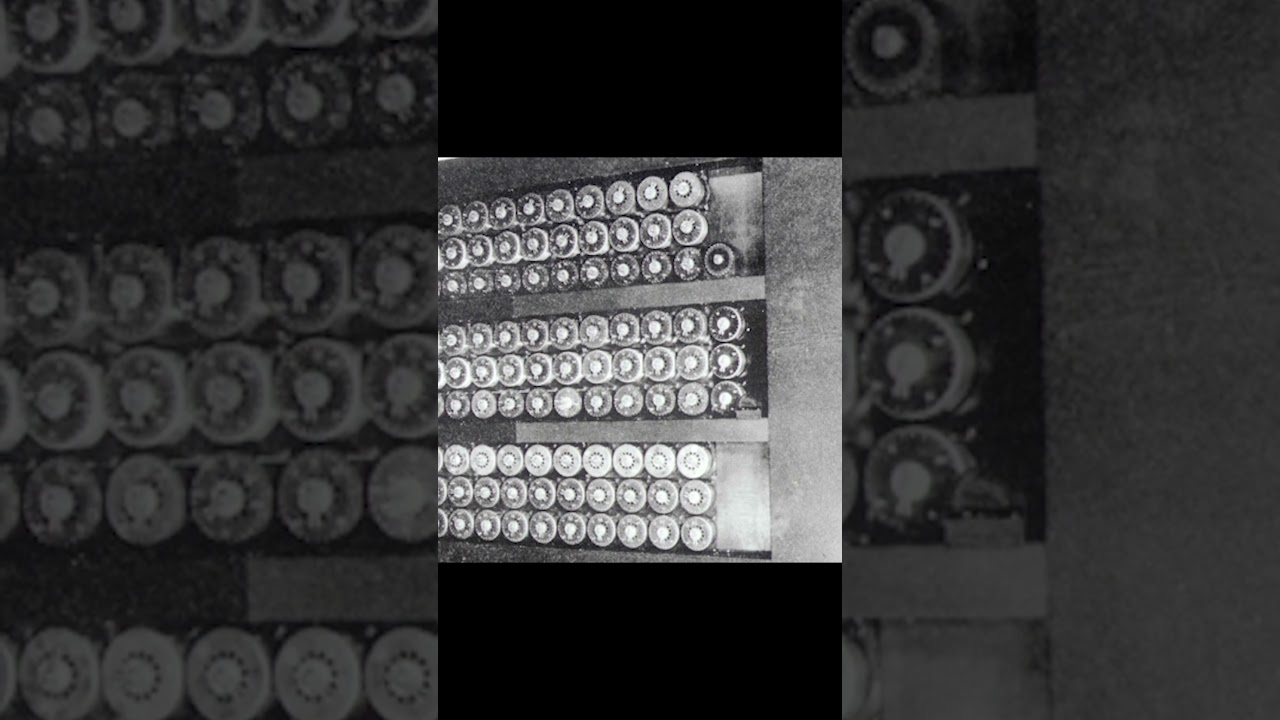
Born in Maida Vale, London, Turing was raised in southern England. He graduated at King's College, Cambridge, with a degree in mathematics. Whilst he was a fellow at Cambridge, he published a proof demonstrating that some purely mathematical yes–no questions can never be answered by computation and defined a Turing machine, and went on to prove that the halting problem for Turing machines is undecidable. In 1938, he obtained his PhD from the Department of Mathematics at Princeton University. During the Second World War, Turing worked for the Government Code and Cypher School at Bletchley Park, Britain's codebreaking centre that produced Ultra intelligence. For a time he led Hut 8, the section that was responsible for German naval cryptanalysis. Here, he devised a number of techniques for speeding the breaking of German ciphers, including improvements to the pre-war Polish bomba method, an electromechanical machine that could find settings for the Enigma machine. Turing played a crucial role in cracking intercepted coded messages that enabled the Allies to defeat the Axis powers in many crucial engagements, including the Battle of the Atlantic.
Born in Maida Vale, London, Turing was raised in southern England. He graduated at King's College, Cambridge, with a degree in mathematics. Whilst he was a fellow at Cambridge, he published a proof demonstrating that some purely mathematical yes–no questions can never be answered by computation and defined a Turing machine, and went on to prove that the halting problem for Turing machines is undecidable. In 1938, he obtained his PhD from the Department of Mathematics at Princeton University. During the Second World War, Turing worked for the Government Code and Cypher School at Bletchley Park, Britain's codebreaking centre that produced Ultra intelligence. For a time he led Hut 8, the section that was responsible for German naval cryptanalysis. Here, he devised a number of techniques for speeding the breaking of German ciphers, including improvements to the pre-war Polish bomba method, an electromechanical machine that could find settings for the Enigma machine. Turing played a crucial role in cracking intercepted coded messages that enabled the Allies to defeat the Axis powers in many crucial engagements, including the Battle of the Atlantic.
Tags and Topics
Browse our collection to discover more content in these categories.
Video Information
Views
212
Likes
3
Duration
0:29
Published
Jul 5, 2023
Related Trending Topics
LIVE TRENDSRelated trending topics. Click any trend to explore more videos.
No specific trending topics match this video yet.
Explore All Trends