AI Just Built Its Own Deep Learning Engine… And It Actually Works
👉 Try Mammouth AI here: https://bit.ly/4sUpPDw Researchers at NVIDIA ran a bold experiment: instead of engineers manually writing a full AI framework, they ...

AI Revolution
25.6K views • Feb 7, 2026
About this video
👉 Try Mammouth AI here: https://bit.ly/4sUpPDw
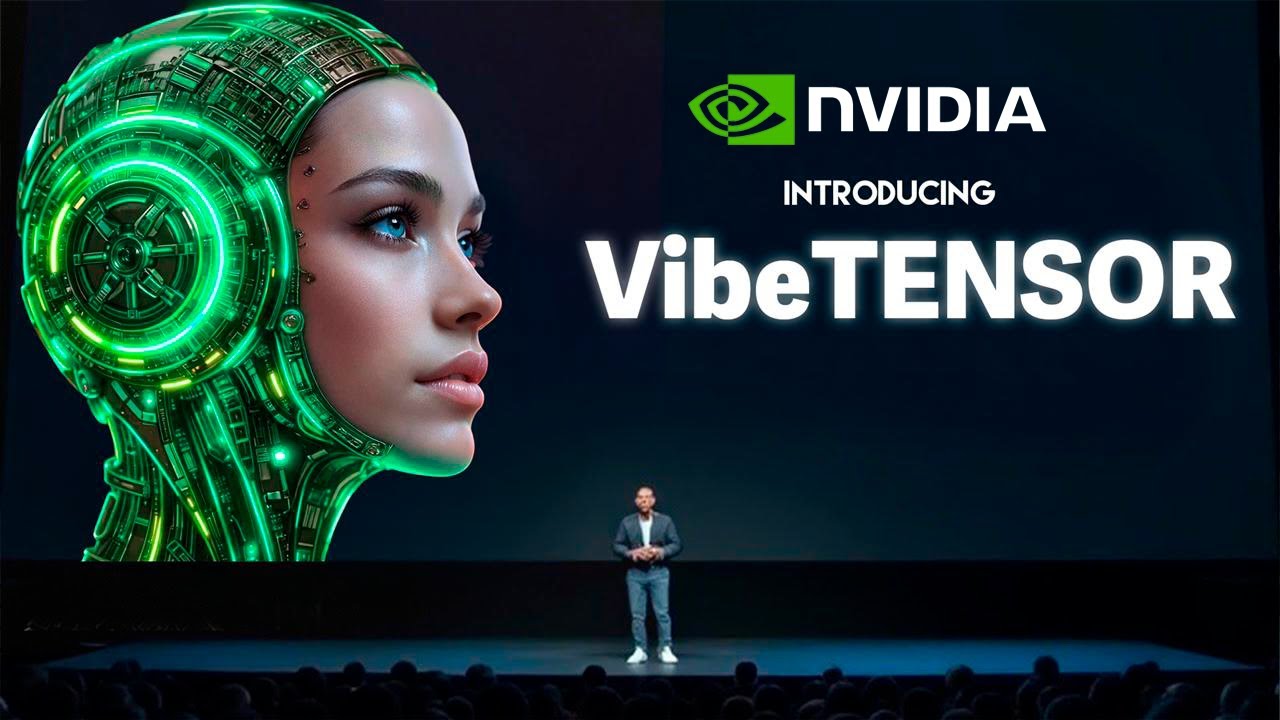
Researchers at NVIDIA ran a bold experiment: instead of engineers manually writing a full AI framework, they let AI coding agents generate a working deep learning runtime that spans Python APIs, a C++ core, and low-level CUDA GPU control. The result is VibeTensor, an open-source research system that behaves like a mini version of PyTorch — but most of its code was proposed, tested, and refined by AI agents rather than humans reviewing every line.
📩 Brand Deals & Partnerships: collabs@nouralabs.com
✉ General Inquiries: airevolutionofficial@gmail.com
🧠 What You’ll See
0:00 Intro
0:32 How AI agents generated a full tensor runtime with memory management and GPU execution
1:23 How VibeTensor mimics familiar PyTorch-style workflows while running on its own C++ and CUDA backend
2:53 How the system implements autograd, dispatchers, and GPU memory allocators from scratch
6:38 How AI-generated GPU kernels compare against PyTorch in performance benchmarks
7:43 How full training runs — including transformers and vision models — validated the system end-to-end
🚨 Why It Matters
This project is an early preview of a new software development model where humans define goals and constraints, while AI agents explore implementation details at scale. Instead of replacing engineers, AI becomes a system-level collaborator — writing code, compiling, testing, and iterating in automated loops. VibeTensor proves that AI can already help construct complex infrastructure software, not just simple scripts.
#ai #nvidia #deeplearning
Researchers at NVIDIA ran a bold experiment: instead of engineers manually writing a full AI framework, they let AI coding agents generate a working deep learning runtime that spans Python APIs, a C++ core, and low-level CUDA GPU control. The result is VibeTensor, an open-source research system that behaves like a mini version of PyTorch — but most of its code was proposed, tested, and refined by AI agents rather than humans reviewing every line.
📩 Brand Deals & Partnerships: collabs@nouralabs.com
✉ General Inquiries: airevolutionofficial@gmail.com
🧠 What You’ll See
0:00 Intro
0:32 How AI agents generated a full tensor runtime with memory management and GPU execution
1:23 How VibeTensor mimics familiar PyTorch-style workflows while running on its own C++ and CUDA backend
2:53 How the system implements autograd, dispatchers, and GPU memory allocators from scratch
6:38 How AI-generated GPU kernels compare against PyTorch in performance benchmarks
7:43 How full training runs — including transformers and vision models — validated the system end-to-end
🚨 Why It Matters
This project is an early preview of a new software development model where humans define goals and constraints, while AI agents explore implementation details at scale. Instead of replacing engineers, AI becomes a system-level collaborator — writing code, compiling, testing, and iterating in automated loops. VibeTensor proves that AI can already help construct complex infrastructure software, not just simple scripts.
#ai #nvidia #deeplearning
Tags and Topics
Browse our collection to discover more content in these categories.
Video Information
Views
25.6K
Likes
743
Duration
11:28
Published
Feb 7, 2026
User Reviews
4.6
(5) Related Trending Topics
LIVE TRENDSRelated trending topics. Click any trend to explore more videos.