AI Agents, LLMs, RAGs & Agentic AI Explained | Rakesh Gohel's Latest Insights 🤖
Discover the differences between AI Agents, LLMs, RAGs, and Agentic AI in this comprehensive overview by Rakesh Gohel. Plus, learn about the new 'AI Agent Engineering' technical cohort—enroll now! 🚀

Rakesh Gohel
54.1K views • Jul 3, 2025
About this video
📌 After months of feedback and iteration, we are finally releasing our first technical cohort, "AI Agent Engineering"
🔗 Enrol here: https://lnkd.in/gDEPcXBB
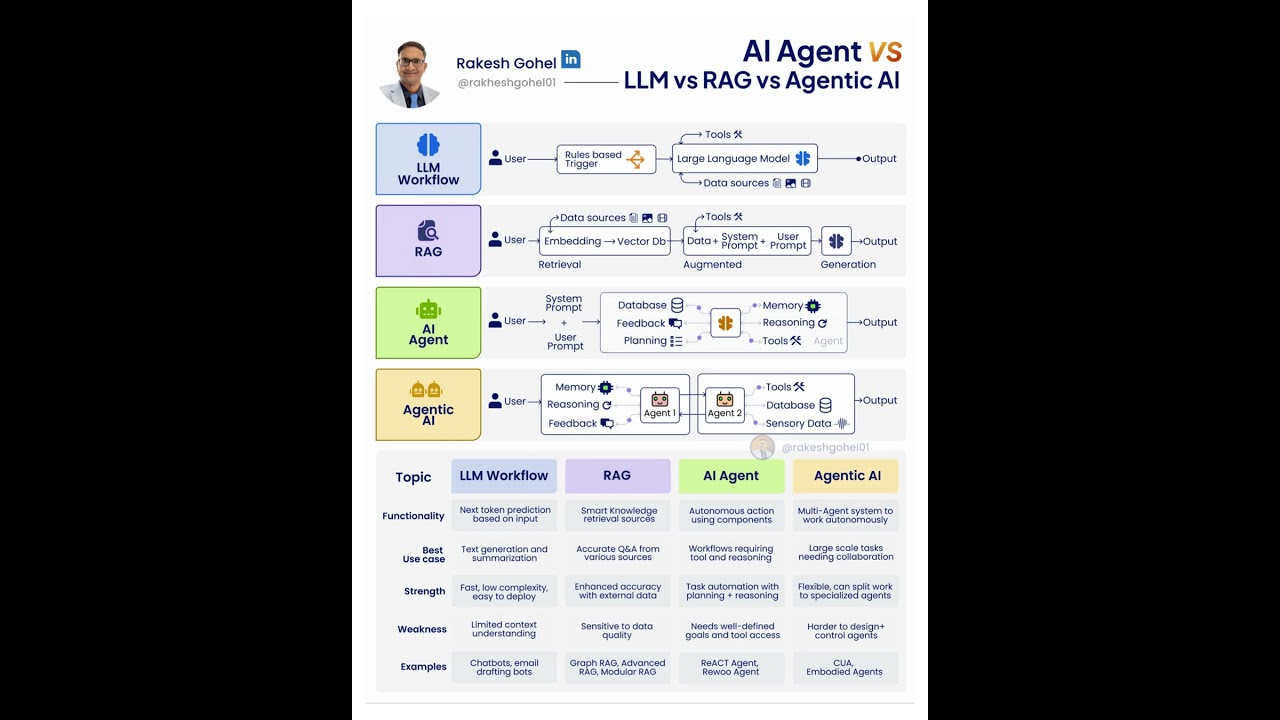
Comparing AI Agents with the modern GenAI architectures
Let us understand the core difference between them...
As GenAI systems become more intelligent, we are looking at a rapid rate of progression.
📌 Starting from level 1, lets see how systems have progressed so far:
1. LLM (Large Language Model)
- Context-Free Generation: Produces text purely from prompt input without external retrieval.
- Fast & Simple: Easy to deploy with low complexity, but limited in context understanding or integrating new data sources.
2. RAG (Retrieval-Augmented Generation)
- Knowledge-Enhanced: Combines LLM output with real-time retrieval from external sources for more accurate, up-to-date responses.
- Data-Dependent Precision: Excels at Q&A and knowledge tasks but is sensitive to the quality and structure of underlying data sources.
3. AI Agent
- Autonomous Task Execution: Uses planning, reasoning, memory, and tool integrations to complete workflows that need decision-making.
- Goal-Oriented Automation: Ideal for well-defined tasks like multi-step data processing or tool-based operations needing structured plans.
4. Agentic AI
- Multi-Agent Collaboration: Deploys multiple specialized agents that coordinate, divide labor, and even negotiate to handle complex problems.
- Adaptive & Persistent: Supports memory, feedback, and reasoning across agents to tackle large-scale tasks requiring ongoing strategy.
📌 Progression
1. LLM Workflow:
- Begins with next-word prediction on static training data—ideal for simple text generation and chatbots with limited context.
2. RAG:
- Enhances LLMs by retrieving real-time external knowledge, grounding responses with accurate, up-to-date information.
3. AI Agents:
- Introduces planning, memory, and tool use to autonomously execute multi-step workflows with reasoning.
4. Agentic AI:
- Evolves into a collaborative multi-agent ecosystem where specialized agents coordinate, share memory, and divide tasks to solve complex problems together.
📌 Use-Cases
1. LLM:
For generating text or answering simple, general questions without needing external data.
2. RAG:
For retrieving and summarizing up-to-date, domain-specific knowledge during a conversation.
3. AI Agent:
For automating single-user tasks that need planning and tool use—like research assistance, report generation, or workflow automation.
4. Agentic AI:
For managing complex, multi-step, multi-user processes where multiple specialized agents coordinate as an ecosystem.
#fyp #aiagents #llm #genai #aiagents #ai
🔗 Enrol here: https://lnkd.in/gDEPcXBB
Comparing AI Agents with the modern GenAI architectures
Let us understand the core difference between them...
As GenAI systems become more intelligent, we are looking at a rapid rate of progression.
📌 Starting from level 1, lets see how systems have progressed so far:
1. LLM (Large Language Model)
- Context-Free Generation: Produces text purely from prompt input without external retrieval.
- Fast & Simple: Easy to deploy with low complexity, but limited in context understanding or integrating new data sources.
2. RAG (Retrieval-Augmented Generation)
- Knowledge-Enhanced: Combines LLM output with real-time retrieval from external sources for more accurate, up-to-date responses.
- Data-Dependent Precision: Excels at Q&A and knowledge tasks but is sensitive to the quality and structure of underlying data sources.
3. AI Agent
- Autonomous Task Execution: Uses planning, reasoning, memory, and tool integrations to complete workflows that need decision-making.
- Goal-Oriented Automation: Ideal for well-defined tasks like multi-step data processing or tool-based operations needing structured plans.
4. Agentic AI
- Multi-Agent Collaboration: Deploys multiple specialized agents that coordinate, divide labor, and even negotiate to handle complex problems.
- Adaptive & Persistent: Supports memory, feedback, and reasoning across agents to tackle large-scale tasks requiring ongoing strategy.
📌 Progression
1. LLM Workflow:
- Begins with next-word prediction on static training data—ideal for simple text generation and chatbots with limited context.
2. RAG:
- Enhances LLMs by retrieving real-time external knowledge, grounding responses with accurate, up-to-date information.
3. AI Agents:
- Introduces planning, memory, and tool use to autonomously execute multi-step workflows with reasoning.
4. Agentic AI:
- Evolves into a collaborative multi-agent ecosystem where specialized agents coordinate, share memory, and divide tasks to solve complex problems together.
📌 Use-Cases
1. LLM:
For generating text or answering simple, general questions without needing external data.
2. RAG:
For retrieving and summarizing up-to-date, domain-specific knowledge during a conversation.
3. AI Agent:
For automating single-user tasks that need planning and tool use—like research assistance, report generation, or workflow automation.
4. Agentic AI:
For managing complex, multi-step, multi-user processes where multiple specialized agents coordinate as an ecosystem.
#fyp #aiagents #llm #genai #aiagents #ai
Tags and Topics
Browse our collection to discover more content in these categories.
Video Information
Views
54.1K
Likes
553
Duration
0:11
Published
Jul 3, 2025
User Reviews
4.4
(10) Related Trending Topics
LIVE TRENDSRelated trending topics. Click any trend to explore more videos.
No specific trending topics match this video yet.
Explore All Trends