Adaptive Filters in Telecommunications 📡
Learn about adaptive filters and their role in noise and echo cancellation in telecom systems.

Ali Nawaz
17 views • Jun 21, 2024
About this video
Introduction
Adaptive filters are crucial components in various applications within telecommunications, including noise cancellation, echo cancellation, and channel equalization. They are designed to adjust their parameters automatically in response to changing signal characteristics, making them highly effective in dynamic environments.
What are Adaptive Filters?
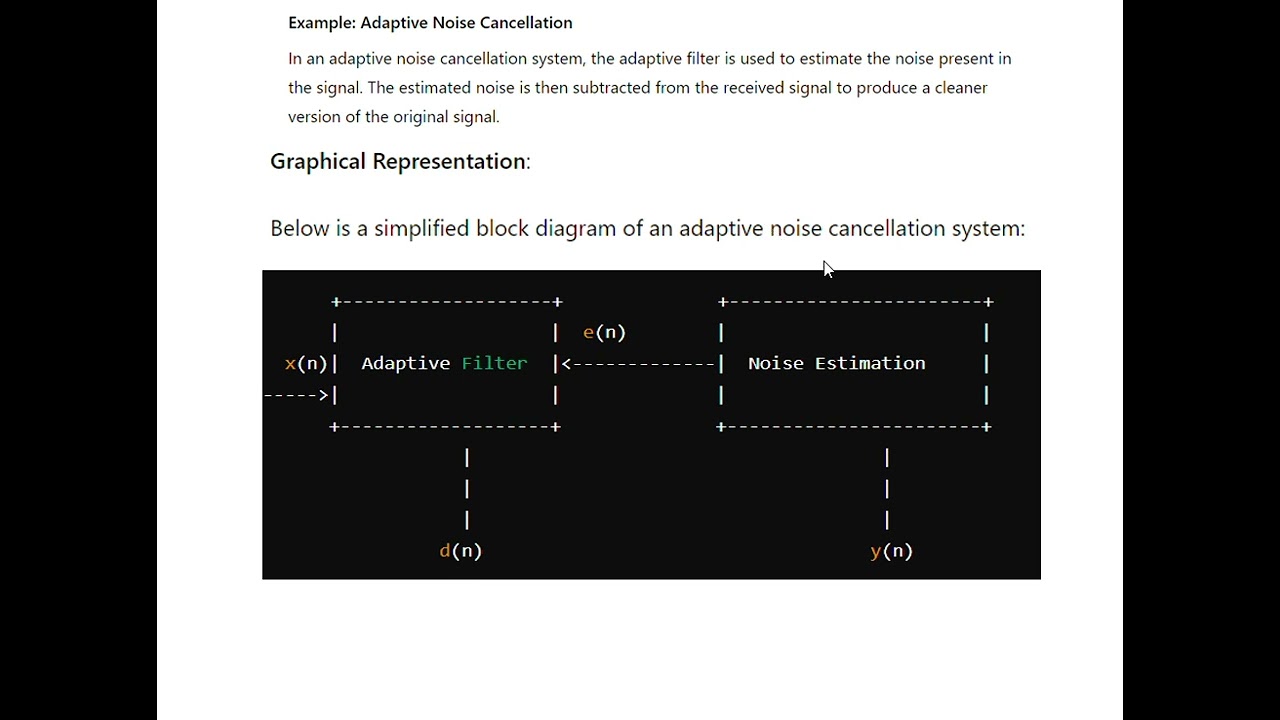
An adaptive filter is a filter that self-adjusts its transfer function according to an optimization algorithm driven by an error signal. The primary objective of adaptive filters is to minimize the error between a desired signal and the actual output signal.
Key Components
Filter Structure: The adaptive filter typically uses structures such as Finite Impulse Response (FIR) or Infinite Impulse Response (IIR) filters.
Error Signal: This is the difference between the desired output and the actual output of the filter.
Adaptation Algorithm: Algorithms such as the Least Mean Squares (LMS), Recursive Least Squares (RLS), and Kalman filters are commonly used to update the filter coefficients.
Adaptive filters are crucial components in various applications within telecommunications, including noise cancellation, echo cancellation, and channel equalization. They are designed to adjust their parameters automatically in response to changing signal characteristics, making them highly effective in dynamic environments.
What are Adaptive Filters?
An adaptive filter is a filter that self-adjusts its transfer function according to an optimization algorithm driven by an error signal. The primary objective of adaptive filters is to minimize the error between a desired signal and the actual output signal.
Key Components
Filter Structure: The adaptive filter typically uses structures such as Finite Impulse Response (FIR) or Infinite Impulse Response (IIR) filters.
Error Signal: This is the difference between the desired output and the actual output of the filter.
Adaptation Algorithm: Algorithms such as the Least Mean Squares (LMS), Recursive Least Squares (RLS), and Kalman filters are commonly used to update the filter coefficients.
Video Information
Views
17
Likes
1
Duration
6:52
Published
Jun 21, 2024
Related Trending Topics
LIVE TRENDSRelated trending topics. Click any trend to explore more videos.